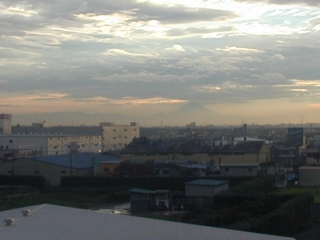
Mt. Fuji on the southwestern horizon as seen from Omiya in mid afternoon during August. Note the high level of cloud cover 6 hours after a Typhoon has passed through. Also the lack of snow at the summit.
The archipelago of Japan
is extremely mountainous and Mt. Fuji, as it's tallest mountain, can be
seen from many of the surrounding prefectures on the main island of Honshu.
Fuji San, as it is respectfully called by the Japanese, is easily visible
on flights into Tokyo's domestic Haneda and more distant Narita international
airports when approaching from the west. It can also be seen towering
majestically above the horizon when approaching the port of Tokyo by sea
from the south.
On a relatively rare clear
summer day in central Tokyo, Mt. Fuji can be seen lying on the distant
horizon to the southwest. From about October onwards, the hint of impending
winter is in the air and the sky is noticeably absent of cloud, particularly
on a moderately windy autumnal day. After mid-October Mt. Fuji can often
be seen topped with a pristine sprinkling of fresh overnight snow close
to it’s summit, which gradually expands elegantly downwards as the new
year progresses and remains defiantly in place until well through Japan's
rainy season in May and June of the following year.
Fortunately,
the mountain is not, or only a little at the beginning of July, snow covered
during the summer climbing season, thus providing a perfect opportunity
to trek up Japan’s most famous mountain, above the blanketing layers of
early dawn mist lying in the valleys of the much smaller mountains below,
and rest in quiet anticipation of catching a glimpse of a Japanese style
sunrise, complete with a crown of multiple sunrays on the eastern horizon.
Depending
upon the phase of the Moon not being so strong as to flood out the view
of the night sky it is possible to have the jet black darkness of Space
and millions of twinkling stars above ones head whilst looking towards
the eastern horizon as it gradually warms in announcement of the approaching
day.
The
coast of Japan, and a hint as to the vastness of the Pacific Ocean beyond
the horizon, as it stretches out virtually unobstructed for several thousand
miles in the direction of The Americas, is clearly visible as the Sun finally
arrives and appears to arc heavenwards on its timeless journey across our
planet's sky.
Considering
this same scene has been repeated daily, exactly on cue, for millions of
years it has always been a surprise to me how few people, especially city
dwellers, have ever taken time out to sit properly and observe the natural
beauty of a sunrise or know just how many stars there really are in the
sky above their heads. A climb of Fuji gives you the opportunity to briefly
escape the exceptional hustle and bustle of life down on the crowded Kanto
plain to experience this firsthand and also provides you with an
interesting conversational ice breaker about something many Japanese have
wished to do at least once in their lives, which is to have climbed Fuji
!
For the more adventurous
trekker, a hike out of season on a carefully chosen blustery and cloudless
day in the Autumn would yield some impressive photos both of and from the
summit.
The sky color at this time
of year is a beautiful deep blue and a polarized filter on your camera
will provide a dramatically contrasting background to your photos. If you
are close by to Fuji on such a day you will instantly recognize the perfect
conditions for such a late season climb, providing you are armed with slightly
more warm clothing than in the summer, but not so much as to be overloaded
with professional winter apparel.
If you contemplate a climb
at this time of year be careful not to get lulled into a false sense of
security without checking the weather forecast in
detail first. If the weather changes to high winds and you have
no tent or appropriate warm and waterproof clothing you will probably die
from exposure. Remember, it is absolutely vital to keep an eye on the weather
at all times, even on a summer climb when Typhoons spawned in the warmer
waters off of Micronesia and the Philippines start their destructive journeys
northwards.
During the summer climbing
season of July and August rest huts open up continuously at various altitudes
on the mountain trail to ease the exertion of your climb. If you become
exhausted or ill it is relatively easy to find sympathetic shelter and
hot food at one of these rest stations.
Outside of these dates the
mountain is ‘closed’. If you would like to climb during this time you are
asked to register your trek with the local Police station for safety purposes.
The main Police Station is in the local town but there is a Koban [Police
Box] at the 5th station halfway up the mountain. The Police Officer I spoke
to there, after I returned down the mountain in complete darkness with
several people in tow last year, spoke excellent English, a rarity in most
parts of Japan even today.
The 5th Station is a collection
of permanent concrete buildings with a gift shop, toilets, food, snacks,
police office, car parking, bus and taxi rank roughly half way up the mountain.
It has a good toll road up to it and is open practically all year round,
even with snow on the ground. In the early climbing season you may wish
to take along a set of clip on crampons for walking.
Incidentally, the area around
Fuji is noted for its natural beauty. There is a large amusement and roller
coaster park as well as fishing, boating and camping opportunities around
the five nearby lakes. Consequently, there is a healthy and friendly tourist
industry in the area which is well used to accommodating the visiting foreigner.
The Fujikyu amusement park is reputed to have the fastest and highest roller
coaster in the World and the train line back to Tokyo stops right outside
of it [second stop from the end of the line]. It is also located right
next to the exit of the expressway coming from Tokyo.
The forest at the base of
Mt. Fuji is also infamous in Japan for disappearing people. Every so often
the local Police arrange expeditions in to it to find the bodies of the
current year’s suicide cases and murder victims that went in there but
never came out again!
Return to:
Greetings
Safe trekking advice
Introduction to Fuji
Getting to Fuji
Climbing up
The summit
Climbing down
What to take with you
Last thoughts
 Return to INSPEC home page