You can climb during the daytime if you wish, but it does not seem to hold the same symbolic significance or excitement as a night climb. Particularly as you do not really know where you are in the dark and experience quite a pleasant surprise at just how high up you actually are when dawn breaks.
A sensible combination is to climb in the day, resting from early evening in one of the higher altitude mountain huts, and waking again to continue your climb shortly after midnight. There is no fixed schedule for this. You just stop and start as and when you please. Simply bear in mind the magical time of 4am to be wherever you want to be to watch the sunrise and also there is a small fee to stay in the shelter of one of the mountain huts.
Choose your preference carefully, bearing in mind your physical ability and health. For those who may be walking disabled progress will be slow but not impossible with an assistant. Preferably you should be able to raise your foot to knee height in order to step up on several of the larger rocks the trail passes over. A wheelchair, however, is impossible without a coordinated team of bearers to lift you up steps and over rocks. Sometimes there are organized climbs for seriously disabled people.
The trail is split into two half way up the mountain, one upwards and one downwards route, both of which run roughly parallel to each other. Because it is difficult to pass others on the narrow upward trail you may not be able to speed on ahead at your best pace to reach the summit quickly because of slower, and often, older or disabled climbers. Patience is the order of the day. Remember, your climb should be an enjoyable experience and not a race against the clock ! You may only climb Mt. Fuji once so after you have got up there you might as well have a good look around rather than rushing back down immediately.
Most overnight climbers on the last bus from Shinjuku will greet the sunrise around the altitude of the 8th station. If you are near a rest station around sunrise it is well worth taking time out and stopping there for a while. Hot drinks are available and other climbers are on hand to take photos of you against the sunrise in return for the mutual favor.
The Kawaguchi-Ko route will bring you to the top of the craters edge on Fuji's east side. For enthusiastic climbers you might like to try timing your climb to be at this higher point at dawn to photograph the sunrise at the Tori gate just a few yards below the top, then walk around to the other side of the crater and see Fuji's vast conical shadow spread over the countryside far below your feet.
There are also several other trails on the South and South-Eastern sides of the mountain with regular transportation access. The travel cost can be slightly higher and less convenient than the Kawaguchi-ko trail, depending upon where you start your journey from. As most travelers would start, or want to return to, Tokyo, this guide concentrates on the Kawaguchi-ko trail. However, some alternative access combinations are:
Rail
1. Shinjuku Stn Chuo Line
train 1hr 5m > Otsuki Junction 50min > Kawaguchi-Ko Stn
2. From Nagoya direction
by Bullet Train > Shin Fuji Stn > Bus to Kawaguchi Ko Stn 2hr
3. From Tokyo direction
by Bullet train > Shin Fuji Stn > Bus to Kawaguchi Ko Stn 2hr
4. From Tokyo direction
by Bullet train > Shin Fuji Stn > Bus to Southern side trails.
Bus/Car
5. Shinjuku Stn 1hr 45min
Bus > Kawaguchi-Ko Stn
6. Shinjuku Stn 1hr 20min
Car by Chuo Expressway > Otsuki Junction > Kawaguchu-Ko exit.
7. Tokyo 1hr Car by Tomei
Expressway > Gotemba Junction > Route 138 1hr > Kawaguchi-Ko
8. Nagoya 4hr 15min by Highway
Bus > Kawaguchi-Ko
9. Nagoya 3hr 15min Car
by Tomei Expressway > Gotemba Junction 1hr > Kawaguchi-Ko
Recommended
route:
For those that don’t mind
a coach ride, the Fujikyu & Keio bus company have an excellent bus
service which departs regularly from JR Shinjuku Railway Station west exit
coach station several times a day and conveniently whisks you efficiently
HALF
WAY UP THE MOUNTAIN TO THE 5th STATION. Shinjuku Station is
located on the JR Yamanote Line which encircles the central part of MetropolitanTokyo
and is located on the west side of the city at roughly 9 o’clock. The train
color is green and the fee from one side to the other is Yen 190.
Locate the west exit inside JR Shinjuku station [it is on the platform 13 and 14 side] and walk 1 minute directly across the road to the Keio Company coach station, which is next door to Yodobashi Camera, one of the biggest electronics stores in Tokyo and on the way to the Keio Plaza Hotel which you will easily see in the distance.
 One
point advice - If you get lost on the west side of Shinjuku Station
ask anybody for ‘Yodobashi Camera’. It is much better known than the Bus
Station which, as of June 25th 2002, is being refurbished. The ticket office
is still in operation but hidden behind some construction panels and not
easily recognizable.
One
point advice - If you get lost on the west side of Shinjuku Station
ask anybody for ‘Yodobashi Camera’. It is much better known than the Bus
Station which, as of June 25th 2002, is being refurbished. The ticket office
is still in operation but hidden behind some construction panels and not
easily recognizable.
2002 Express Bus Timetable
to 5th Station - Fare ¥2,600 one-way - Telephone
03-5376-2222
| X | # | # | X | X | X | |
| Shinjuku | 7:45 | 8:45 | 10:55 | 16:50 | 17:50 | 19:50 |
| Fuji | 10:10 | 11:10 | 13:20 | 19:15 | 20:15 | 22:15 |
| X | X | X | # | X | # | |
| Fuji | 11:00 | 12:00 | 13:00 | 14:00 | 15:00 | 16:00 |
| Shinjuku | 13:25 | 14:25 | 15:25 | 16:25 | 17:25 | 18:25 |
Blue X: Daily service July 1 through September
1
Red #: Weekend and Holiday service April 27
through June 30 and September 2 to November 4
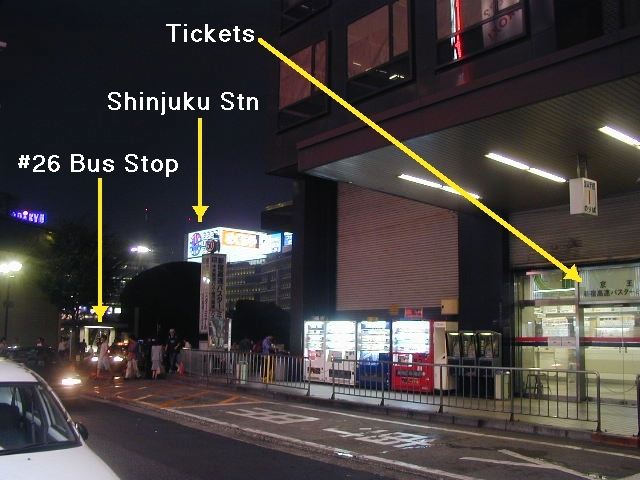 View
of the bus station looking back towards Shinjuku railway station west exit
View
of the bus station looking back towards Shinjuku railway station west exit
Other buses stop at the town at the base of Fuji, where you can catch a separate local bus up to the 5th station [Yen 1,700 one-way, about 30 minutes]. The bus station is immediately in front of the local railway station and next to a small economy hotel.
Another option is to start your entire trek from scratch at the town and walk up the entire mountain from the 1st station if you have more time available.
Most visitors start from the 5th Station both for convenience and because it provides the ‘best deal’ for your money from Tokyo with a one-way coach ticket costing only Yen 2,600 for the 2hour and 25 minutes ride.
[The US$ exchange rate in June 2002 was Yen 123 to US$ 1 and Yen 180 to the Sterling Pound].
There is also car parking available at the 5th station for up to 400 cars and similar large car parks at several other locations around the mountain. The road from the base of Fuji to the 5th station is a private toll road. Also, although it is possible to use public roads to drive from Tokyo to Mt. Fuji, the fastest route is almost always to use the westbound Chuo Expressway from Shinjuku. Branch off left [southwards] at Otsuki junction and the expressway ends at the bottom of Fuji, where you will do a quick jiggle from one road to another through a couple of sets of traffic lights and pay again to use the private toll road to climb up to the 5th station. It will take less than 2 hours to drive there by yourself from Shinjuku as the buses run strictly to the speed limit.
The last coach departure of the evening is very popular and often consists of a fleet of several vehicles loaded with enthusiastic hikers of all ages who have just had time to finish work and jump on the next bus, particularly on a Friday evening. It is not unusual to see 8 year old children and seniors onboard, although most climbers range from young adults to young seniors. More than one coach may leave at the same time, so they travel in convoy and terminate halfway up the mountain at the 5th station at about 10pm, depending upon traffic conditions.
It is always best to make a reservation in advance due to the popularity of the seasonal climb and also to confirm where the bus will terminate on the day of the week and time you wish to travel. The ticket can be purchased inside the Coach Station office [Telephone 03-5376-2222]. If you decide to go on the spur of the moment tell the ticket desk clerk and hang out next to the counter. If space is still available they will sell you a ticket. During the summer season many coaches run together in convoy so you might be lucky and find seats on the last coach if you have not booked in advance. Sometimes Japanese coaches have a third seat which folds down in the aisle. It is rather uncomfortable but they may offer this if regular seats are booked.
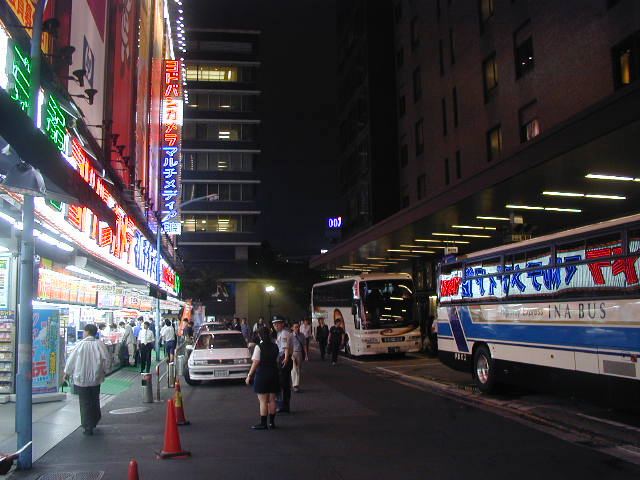 Yodobashi
Camera opposite the bus station
Yodobashi
Camera opposite the bus station
For those departing from the suburbs of western Tokyo area the fare is slightly cheaper as the coach also picks up at certain places along the Chuo expressway, including Jindaiji, Fuchu, Hino and Hachioji cities. You should make a telephone reservation in advance, receive a booking number then wait at the special bus stop on the expressway. For non-Japanese speakers it is much better to go to Shinjuku Bus Terminal and board the bus there to avoid confusion with flagging down the correct bus as it speeds along the highway towards you, especially at night. Some of the coaches do not have the destination written in English on the front of the bus so you MUST be able to read Japanese in order to flag down the bus safely. The driver will usually be aware he has a passenger to pickup but they may assume it is not a foreigner and continue on. Drivers slow down and pull off the expressway but do not always stop. Similarly, there are many buses to different destinations which pass the same stop, which can also cause confusion if you look lost. However, if returning from Fuji by bus it is possible to save time and alight at these stops rather than going all the way back to Shinjuku. An announcement is made close to the stop so reach up and press the buzzer above the seat. Move to the front of the bus after it has safely stopped.
One
point advice - reserve your seat and check the coach schedule for
your selected day and destination in advance.
One
point advice - Japan has a one week summer holiday called O-Bon
in mid-August. Traffic conditions and crowding can be extremely bad during
this time. Choose a day before or after the O-Bon period and preferably
avoid weekends because they are definitely more popular. The trail ahead
of you can become more congested than normal with the volume of climbers,
so the less people on your chosen day the better as it will allow you to
progress faster. You may also like to check the moon phase for your chosen
climbing day. A climb during a full moon is good because the ambient light
on the trail is better but it’s intensity blots out stars which you cannot
see from the city. Binoculars or a telescope are a good thing to take along
with you.
One
point advice -Summer is also Typhoon season. Keep an eye on the
weather conditions before you depart. If you succeed in climbing Fuji without
getting washed away by the dangerous torrential rain and extremely high
winds a Typhoon brings it would be a shame not to see the beautiful sunrise
because of heavy cloud at higher altitudes. Bottom line is a Typhoon is
the
Asian equivalent of a Hurricane!! If there is a Typhoon passing
through DO NOT even think about climbing until it has passed. Also, bear
in mind that the weather system associated with a Typhoon extends for hundreds
of miles. You wont get a good view with the wide cloud cover associated
with it.
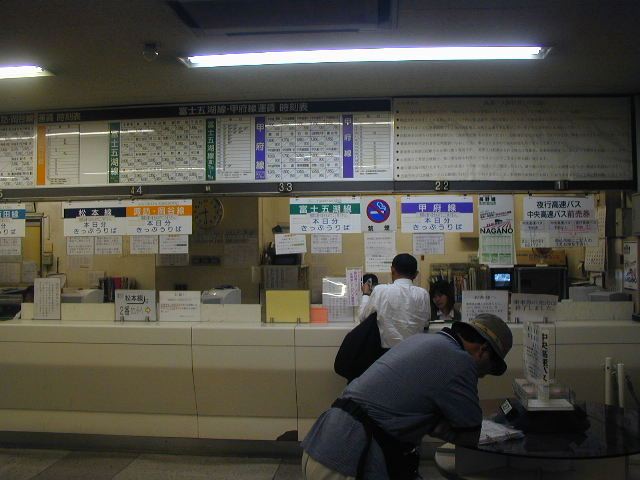 Ticket window
Inside the coach station there are several windows to buy tickets from, depending upon your destination. You will see Fuji listed on a green colored sign above a ticket window towards the right side of a bank of windows facing you inside the office. In English it may also say ‘Kawaguchi-Ko’, which is one of the five lakes at the base of Fuji. This is the window you need even though you will probably elect to bypass Kawaguchi-ko and continue directly up the mountain to the 5th station onboard the direct bus service.
Your reservation is held under the telephone number you gave them when you called so even if you do not speak Japanese you will get by with hand signals and saying "Mount Fuji and my telephone number is…". If you are picked up on the expressway the driver will also ask you your telephone number and you must pay him cash when getting onboard the bus.
Your ticket will indicate your seat number. Also, the coach number if there is a convoy of more than one bus leaving at the same time. Show your ticket to the nearest driver and he will make sure you board the correct coach. The coaches line up over the road and not directly outside of the ticket office, at stop #26.
Before you board you may like to do some shopping. You can buy normal and professional grade film, filters or simple disposable cameras in Yodobashi Camera opposite the bus station. The variety of products they have is enormous. They have a professional corner in the basement if you want to buy film with high ASA exposures for night or astro photography and stock up to 3200 ASA film. There is also a digital camera corner if you need to purchase more memory or batteries.
In the immediate area there
is also a McDonald's, Starbucks and Doutor take out coffee shop. Shinjuku
main post office and several bank ATM’s, including Citibank, are within
2 blocks walk. There are also two good outdoor equipment shops in Shinjuku
and one, Ishii Sports, is located about two minutes walk away on the other
side of Yodobashi Camera. If you need a rucksack, walking stick,
freeze dried food, fuel, tent, skis, etc., they have it all. The prices
are not discounted but they generally have whatever you need. There are
also several sports shops on the south and east sides of Shinjuku Station.
One
point advice - Anticipate to spend some time in the area of the
bus station to visit the ATM for extra cash, get some dinner and a snack
for breakfast the next morning, buy extra film and batteries and your coach
ticket.
Hot and cold food and drink is available, both as you climb, and at the top of Fuji. It is not so readily available as you descend because there are almost no mountain huts or toilets on the descent route. This is a pity because the descent is monotonous winding back and forth and a rest hut would provide a welcome distraction as well as a reminder to drink and eat something to keep your strength up.
Prices on Fuji are, naturally, more expensive because of the transportation costs. Supplies are delivered by helicopter, tractor and even hand carried by local porters.
As an example, expect to
pay Yen 300 [normally Yen 120] for a small can of drink, Yen 500 [normally
Yen 150] for a small 500ml PET bottle and Yen 800 [normally Yen 150] for
a hot cup of instant noodles. Taking some drink and snacks with you will
help to ease this extra expense. A can of oxygen is also highly recommended
as a comfort standby. These can be purchased in any sports shop, outdoor
goods and some department stores for around Yen 600 per can. Prices for
canned oxygen at the huts on Fuji is at least Yen 1,000 per can.
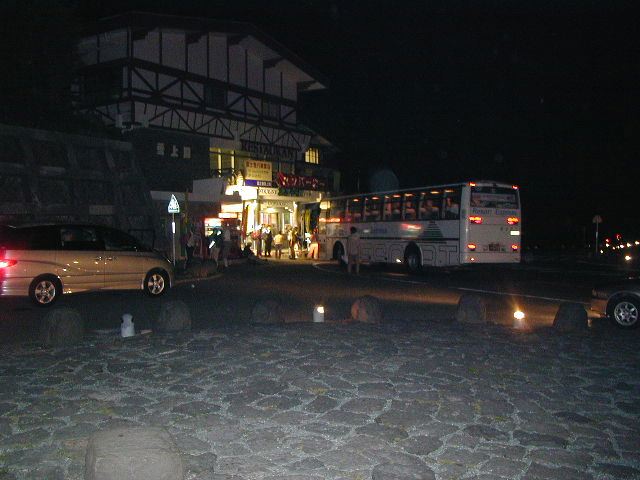 Mt.
Fuji Go-Gome [5th station]
Mt.
Fuji Go-Gome [5th station]
One
point advice - On Fuji, garbage is subject to Sir Isaac Newton’s
rule of what goes up must come down. That includes the instant noodle cup
or other wrappings you purchase along the way. In the past the trail has
been littered with garbage during the summer climbing season. Half way
through the 2001 season I only saw three cigarette butts throughout my
entire journey. A significant improvement and praiseworthy evidence of
volunteer groups helping to keep the trail clean.
One
point advice -The Shinjuku ticket office is often very crowded with
people so even if you have a reservation please get there at least 30 minutes
before the coach departs so you can get in the queue. If you only have
5 minutes to spare before your bus leaves you may hear an assistant at
the window shouting in Japanese if there are any more passengers for Mt.
Fuji with reservations. Speak up and move forwards quickly.
One
point advice - Unfortunately, not all the buses in the convoy have
a toilet onboard ! A toilet can be found downstairs in the basement of
the bus station along with a small and smokey waiting area and snack shop.
After that, the next bathroom is at Mt. Fuji’s 5th station where the bus
terminates. It is located inside the white building in the picture of buses
arriving at the 5th station at 10pm. It is a ‘Tip Toilet’ where you will
be expected to leave Yen 100 per visit. The toilet is very clean and presentable.
As you ascend, the toilets will still protect your privacy but become more
rudimentary due to the lack of running water. They all require Yen 100
for their use. Do not forget to carry some toilet paper just in case. Alternatively,
there are better toilets in Yodobashi Camera opposite the ticket office.
Shinjuku Station to Subashiri via ODAKYU private railway.
This route can also be accessed from Shinjuku station but is not recommend for going to, only returning from, Fuji because of the Sunabashiri. The Sunabashiri is a volcanic sand slope which you can descend much quicker.
This particular route is called the Subashiri route and is accessed
by special train 4 times per day in each direction. At the bottom of the
Sunabashiri, catch the bus to Gotemba and board the Odakyu line train.
Reservations can be made for the train in advance. The train name is Asagiri.
| Asagiri | Number 1 | Number 3 | Number 5 | Number 7 |
| Shinjuku | 07:20 | 10:15 | 13:40 | 17:40 |
| Gotemba | 08:56 | 11:53 | 15:24 | 19:17 |
| Number 2 | Number 4 | Number 6 | Number 8 | |
| Gotemba | 08:25 | 10:54 | 15:54 | 17:55 |
| Shinjuku | 10:03 | 12:29 | 17:27 | 19:35 |
Note: This train also stops at Numazu, Susono, Surugaoyama and Matsuda.
Also, trains back to Shinjuku arrive a couple of minutes earlier on Sat,
Sun, National Holidays.
Return to:
Greetings
Safe trekking advice
Introduction to Fuji
Getting to Fuji
Climbing up
The summit
Climbing down
What to take with you
Last thoughts
 Return to INSPEC home page